Why Theatre Subtitle Software Should Parse Scripts Before Using AI
When a theatre subtitle system misreads a cast list as dialogue, the problem does not stay inside the parser. It becomes a bad cue in rehearsal, a confused operator, and possibly the wrong line on screen during a live show.
That is why theatre subtitle software should not treat a script as plain text before asking AI to classify it. A script is a structured document. Indentation, spacing, capitalization, punctuation, and formatting often carry more structural meaning than the words themselves.
In March 2026, we published a technical post explaining why theatre script parsing is a geometry problem. This article continues that thread with the current direction of SurtitleLive’s script-to-subtitles pipeline.
Since then, SurtitleLive’s parser has continued to move in a more deterministic direction.
That matters because theatre subtitles and surtitles are not generated for a static document. They become live cues. If a script parser mistakes a cast list for dialogue, or a stage direction for a spoken line, that mistake can reach rehearsal review and eventually the operator workflow.
Our current direction is therefore simple: use document structure first, use AI selectively, and keep monitoring parser behavior as more script formats are tested.
In simplified form, the workflow is:
DOCX -> structural extraction -> paragraph signals -> block grouping -> archetype detection -> body zoning -> selective AI review -> editable cue draft
Why Deterministic Parsing Comes First
AI can be useful for ambiguous cases, but live subtitle preparation needs repeatability. Given the same script, a parser should make the same structural decision every time unless the system is changed deliberately.
Deterministic parsing gives the system that baseline. It reads the script’s formatting before asking an AI model to interpret difficult regions.
For a theatre team, this means the workflow is not simply “upload a script and hope the model understands it.” The system first looks for concrete evidence:
- speaker labels
- indentation patterns
- paragraph spacing
- stage-direction formatting
- colon, dash, period, and tab separators
- front matter such as title pages, cast lists, and production notes
When those signals are strong enough, the parser can classify the block without AI review.
A Simple Example: Cast List or Subtitle Cue?
Consider a small fragment from the beginning of a script:
CAST

HAMLET
OPHELIA

ACT I

HAMLET
    To be, or not to be.
A line-by-line AI approach may see HAMLET as a likely speaker label in both places. In the cast list, however, HAMLET is metadata. In the body of the script, HAMLET is a speaker label that leads to a subtitle cue.
The difference is not the word. The difference is the document region.
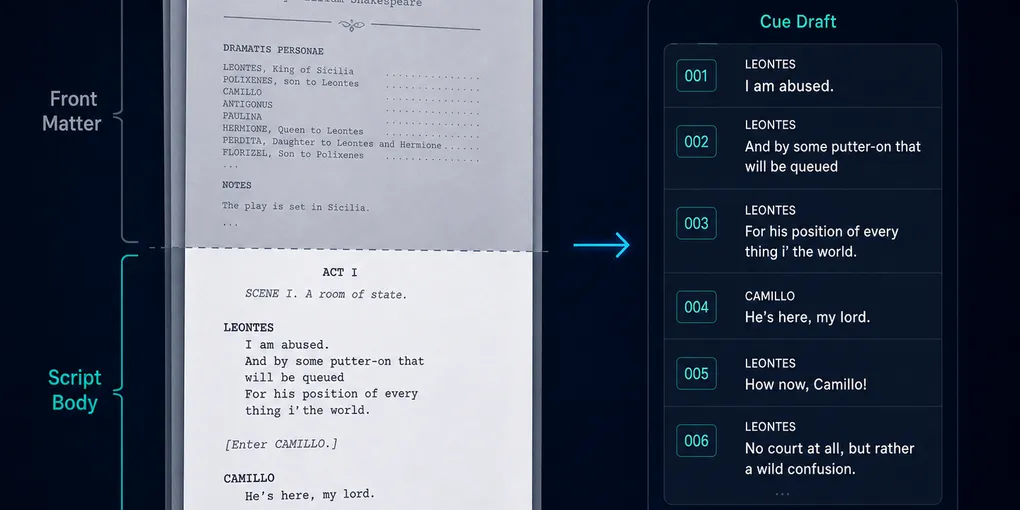
That is why body-first zoning matters. The parser first tries to separate front matter from the performable body, then applies dialogue rules to the region where dialogue is expected. This reduces the chance that cast lists, title pages, or production notes become rehearsal cues.
The Current Parsing Direction for Script to Subtitles
The parser now works as a staged pipeline rather than a single AI classification step. The exact implementation continues to evolve, but the core stages are stable in principle.
1. Extract document structure
For .docx files, SurtitleLive reads structured document data rather than relying only on plain text. This preserves information such as indentation, paragraph alignment, spacing, inherited Word styles, and run-level formatting such as italic or bold text.
That information is important because many theatre scripts use typography as grammar. A centered all-caps line may be a speaker. An indented line may be dialogue. An italic line may be a stage direction. Plain-text conversion can destroy those cues.
2. Normalize paragraphs into structural signals
Each paragraph is converted into a set of structural signals. These include whether the line appears to contain a speaker prefix, whether it is bracketed, whether it uses formatting associated with stage directions, and whether capitalization is useful for the writing system in question.
The system does not treat all scripts as English scripts. For writing systems where uppercase is not meaningful, caps-based heuristics are reduced or disabled so they do not create false confidence.
3. Build script blocks
Paragraphs are then grouped into script blocks. A block might represent a spoken line, a speaker label with following dialogue, a stage direction, a heading, or a region that still needs review.
This step is based on layout and structure, not literary interpretation.
4. Detect script layout archetypes
Scripts do not all use the same layout. Some use Speaker: Dialogue. Some put the speaker on one line and the dialogue below. Some use period or dash separators. Some mix conventions within the same file.
SurtitleLive therefore looks for layout archetypes before applying parsing rules. Examples include:
| Archetype | Common pattern |
|---|---|
| Colon dialogue | HAMLET: To be or 張三:今天下雨 |
| Speaker on its own line | HAMLET followed by an indented dialogue line |
| Period speaker | AMLETO. Essere o non essere |
| Mixed layout | Different conventions in different regions of the same script |
| Unknown or weak evidence | Front matter, appendices, or ambiguous regions |
This lets the parser avoid forcing one rule set across a whole document when the document itself changes format.
5. Separate front matter from the body
Many scripts begin with title pages, cast lists, notes, or production information. Those pages can look structurally similar to dialogue even though they are not part of the performance text.
SurtitleLive uses body-first zoning to reduce that risk. The parser tries to identify where the performable script body begins, so that front matter does not distort dialogue detection.
6. Use AI for ambiguous regions
AI still has a role. It is most useful when the deterministic evidence is weak or conflicting.
The design goal is not to remove AI from the workflow. The goal is to avoid asking AI to decide blocks that already have strong structural evidence. When AI review is needed, it should focus on genuinely ambiguous regions and should be calibrated against examples from the same document where possible.
Sequence Review and Recovery
Some parser errors only become obvious when looking at the sequence of blocks. For example, a heading followed by another heading may be plausible in front matter but unlikely inside a dialogue-heavy scene. A speaker name that appears once may need different treatment from a repeated character label.
SurtitleLive uses sequence-level review to improve these decisions. Internally, this includes decoder and smoothing logic that considers neighboring blocks, document regions, and speaker evidence together rather than treating every paragraph in isolation.
This is an important difference from simple line-by-line parsing. Theatre scripts are sequential documents. The surrounding structure often tells the parser whether a line is dialogue, a speaker cue, a heading, or something that should be reviewed.
How We Check Parser Changes
Parser changes are tested against curated script fixtures and regression cases before they are treated as safe. The purpose is practical: a change that improves one layout should not quietly break another.
Those checks focus on questions such as:
- Did a known speaker line remain a speaker line?
- Did a stage direction stay out of the subtitle cue list?
- Did front matter remain separate from the performable script body?
- Did multilingual or non-English punctuation continue to parse as expected?
- Did an ambiguous block remain reviewable rather than being over-classified?
This is not a claim that every theatre script can be parsed perfectly. Scripts vary widely, especially rehearsal drafts, scanned or retyped material, heavily adapted scripts, and files with inconsistent formatting. Human review remains part of the preparation workflow.
What This Means for Users
For production teams, deterministic-first parsing is meant to make script preparation more predictable. This is especially relevant for AI theatre subtitles, opera surtitles, and multilingual cue drafts where a wrong structural decision can create review work later.
It helps SurtitleLive:
- preserve layout evidence from Word scripts
- detect common theatre dialogue formats
- reduce avoidable AI interpretation where structural evidence is already clear
- keep ambiguous regions visible for review
- support multilingual script conventions more deliberately
The practical goal is not full automation. The goal is a cleaner draft that a human can review, correct, translate, and rehearse before performance.
For operators, this means fewer avoidable wrong cues and a cleaner rehearsal handoff.
For producers, it means less manual formatting work before the team can review a cue draft.
For accessibility and language teams, it means translations and audience-facing surtitles can be reviewed against a more stable script structure before live delivery.
What This Does Not Mean
This architecture has limits.
It does not mean every script will parse correctly on the first attempt.
It does not mean AI is never used.
It does not mean every language, layout, or rehearsal draft has the same parser confidence.
It does not replace human review before a show.
It also does not freeze the system in its current form. Script parsing is one of the parts of SurtitleLive we will continue to monitor closely. As more real scripts, layouts, and language conventions are tested, we expect to keep adjusting the rules, review thresholds, regression cases, and AI handoff behavior where needed.
The Direction: AI as Review Support, Not the Whole Parser
The architectural direction can be summarized like this:
| Area | Earlier direction | Current direction | User benefit |
|---|---|---|---|
| Script evidence | Layout clustering and AI classification | Structured document extraction plus deterministic signals | More predictable script intake |
| Layout handling | Broader document-level assumptions | Region and archetype-aware parsing | Better handling of mixed script formats |
| Front matter | Easier to confuse with dialogue | Body-first separation before cue detection | Fewer cast-list or title-page false cues |
| AI role | More central to classification | Selective review for ambiguous regions | Less avoidable AI interpretation |
| Reliability work | Heuristic repair | Regression checks and sequence-aware review | Safer parser changes over time |
This direction is deliberately conservative. In live theatre, a subtitle system should not depend on AI confidence alone when the document structure already provides stronger evidence.
AI is useful, but it is not the whole parser. For SurtitleLive, the stronger path is to combine deterministic script structure, targeted AI review, human preparation, and continued monitoring of parser behavior over time.
If your team is still converting scripts manually into slide decks, or rebuilding theatre surtitles line by line before rehearsal, SurtitleLive can help turn structured scripts into editable cue drafts for review and live delivery. You can learn more on the SurtitleLive features page or the AI script to theatre subtitles page.
FAQ
Q: What is deterministic script parsing?
A: Deterministic parsing uses fixed rules based on document structure, such as indentation, spacing, punctuation, and formatting. Given the same input and the same parser version, it should produce the same structural result.
Q: Why not use AI for every line?
A: AI can help with ambiguous regions, but many theatre script decisions are structural rather than semantic. If formatting clearly identifies a speaker, dialogue line, or stage direction, a deterministic rule is usually more repeatable.
Q: Can AI create theatre subtitles automatically?
A: AI can help prepare a draft, but a production team should still review cue structure, translation choices, timing, and audience delivery before performance. SurtitleLive treats AI as part of the preparation workflow, not as a replacement for show review.
Q: How does SurtitleLive convert scripts into subtitle cues?
A: SurtitleLive reads document structure, identifies script blocks, detects likely layout patterns, separates front matter from the performable body, and creates an editable cue draft for review. Ambiguous regions can receive selective AI support.
Q: Why is DOCX formatting important for theatre surtitles?
A: Many scripts use formatting as structure. Speaker labels, dialogue, headings, and stage directions may be separated by indentation, spacing, capitalization, or italic text. Preserving those signals improves subtitle cue detection.
Q: What is a script archetype?
A: A script archetype is a recurring layout pattern, such as speaker names on their own line, colon-separated dialogue, or period-separated speaker labels. Detecting the pattern helps the parser choose the right rules for that region.
Q: Does this remove the need for human review?
A: No. SurtitleLive aims to produce a clearer review draft, not a fully automatic final show file. Teams should still review cues, translations, timing, and audience delivery before performance.
Q: How will SurtitleLive improve this system over time?
A: We will continue monitoring parser behavior through regression cases, real script formats, and production feedback. When the system shows repeated uncertainty or avoidable errors, we can adjust parsing rules, review thresholds, and AI handoff behavior.